
The Machine Guard That Wasn't Put Back
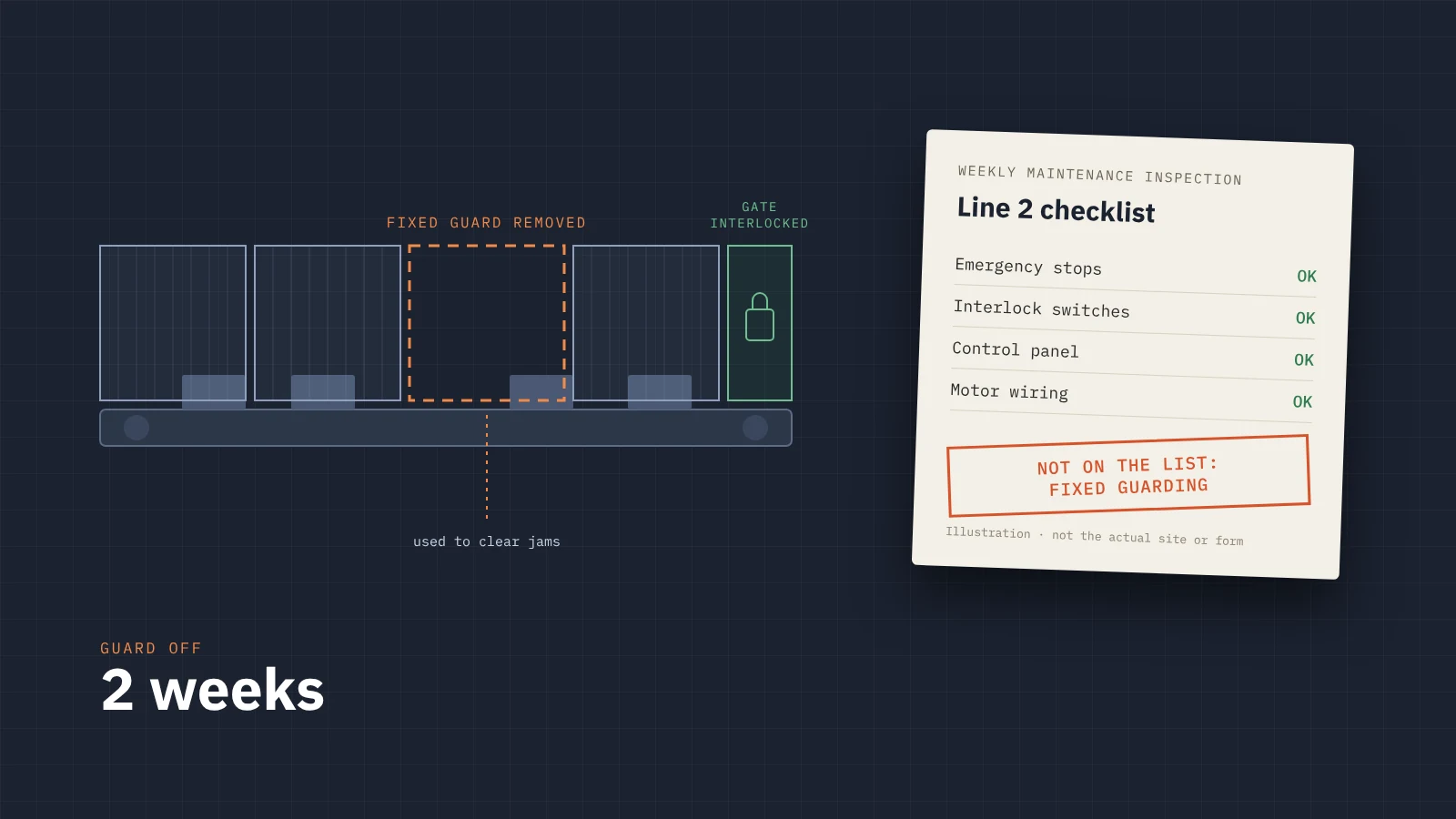
On 19 August 2025, a box jammed in a rack loader at a fish processing plant in Peterhead, Scotland. It had stuck too high in the loader cage to reach from the floor. A chargehand, then 30, went into the production line through a gap in the guarding, climbed onto the conveyor and pressed down on the lid to free it. He had not isolated the power.
The machine restarted. His right arm was pulled into the pusher section and he was drawn further in until his head touched moving parts. A colleague heard him shouting and isolated the machine. He was taken to Aberdeen Royal Infirmary with a fractured jaw and injuries to his chest and arm, and needed metal plates fitted in his jaw. He has since made a full recovery.
On 28 October 2026, Lunar Freezing and Cold Storage Company Limited was fined £245,000 at Peterhead Sheriff Court. The company pleaded guilty to breaching Regulation 11 of the Provision and Use of Work Equipment Regulations 1998 (PUWER) and Section 33(1)(c) of the Health and Safety at Work etc. Act 1974.
What the HSE investigation found
The gap the chargehand used was not part of the design. About two weeks earlier, a section of fixed guarding beside the line had been removed during maintenance, and nobody put it back.
The line already had a safe way in. The proper entry point was an interlocked gate that shuts the machinery off when it is opened. With the fixed guard missing, there was a shorter route that skipped the interlock entirely.
According to HSE, staff had used that gap several times to clear jammed boxes. Maintenance staff knew the guard was missing and had seen people using the gap, and the guard still was not reinstated. The in-house maintenance team ran a weekly inspection, but its checklist did not cover non-electrical fixed guarding.
HSE concluded that the incident would not have happened if the guarding had been in place. Inspector Nicky Smith put the lesson in one line: "Guards must be kept in place, and checks must cover every guard, not just the electrical ones."
Reading it as an investigator
A report on this incident could stop at the person. He entered a hazardous area without isolating. That sentence is accurate, and it explains almost nothing. Several people had done the same thing in the previous fortnight, and the people responsible for the guard had watched them do it.
The more useful questions are about the barriers, taken one at a time.
The fixed guard was absent. It came off for a maintenance task. Plants usually control this with a permit or a job card that does not close until the guard is refitted and checked. Here the guard stayed off for two weeks, so the return-to-service step either did not exist or did not hold.
The interlocked gate was intact and bypassed. An interlock only protects people who use the gate it is fitted to. Once a faster route existed, the gate stopped being the way in.
The weekly inspection was partial. It ran on schedule and checked what it was written to check. Fixed mechanical guards were outside its scope, so the most obvious defect on the line was never going to appear on it. An inspection form defines what gets looked at. Anything outside the form is easy to walk past every week.
Supervision saw the workaround and let it run. The HSE summary says maintenance staff knew the guard was missing and had seen the gap in use. The investigation should find out why that knowledge did not turn into a stop or a repair. The usual reasons are unclear ownership between production and maintenance, or a habit of treating a missing guard as a maintenance backlog item instead of a hazard.
Jams were a known, repeated task. A box sticking high in the cage was frequent enough that people had a routine for it. A recurring jam is a design and maintenance problem in its own right. Every jam is a moment when someone needs to reach into the machine.
Actions that would hold
When we write corrective actions for a case like this, we work up the hierarchy of controls and give each one an owner role and a date.
- Refit the guard today, and check every other fixed guard on site against the drawings while you are at it.
- Make guard removal part of the maintenance permit, with a sign-off that the guard is back and tested before the line restarts.
- Add every fixed guard to the inspection checklist by location, so a missing one is a failed line on the form.
- Find out why boxes jam high in the loader and fix the cause, so fewer people need to reach in at all.
- If clearing a jam still needs access, write a clearing procedure that goes through the interlocked gate with isolation, and brief it at the line.
- Agree who owns a missing guard between production and maintenance, and give anyone who sees one the authority to stop the line.
Each of these should close with evidence, such as the refitted guard and the revised checklist. After a few months, check whether the jams and the workarounds have actually stopped.
Where Intero fits
Intero is built for this part of the job. An investigator describes what happened and adds the photos and statements they have. Intero asks the follow-up questions a lead investigator would, one at a time, including the control that should have stopped it and what was different that day.
In the analysis, each barrier is graded held, failed, partial, absent or unknown, and contributing factors are set out from the task through to the organisation. Every finding cites the evidence it rests on. If the maintenance procedure or the inspection checklist is in the organisation's library, Intero reads it with the case, so a checklist that never mentions fixed guards shows up as part of the analysis.
Corrective actions are written up the hierarchy of controls and each traces to a finding. When an action is finished, its owner is asked by its horizon whether the fix held, and Intero looks through later cases for the same failure coming back.
You can see how a case runs in Intero and what the workspace includes.
A check worth doing this week
Walk one production line with the weekly inspection form in hand. Mark every guard that the form does not mention. Then ask the people who clear jams on that line how they actually do it.
If you want to see how Intero takes an incident like this from the first report to a fix that holds, book a demo.
---
Sources
- Health and Safety Executive, Fish processing firm fined almost a quarter of a million pounds after worker's arm pulled into machine after safety guard left off, 29 October 2026.
- Health and Safety Executive, The safe isolation of plant and equipment (HSG253).