
Not Fit for Continued Service
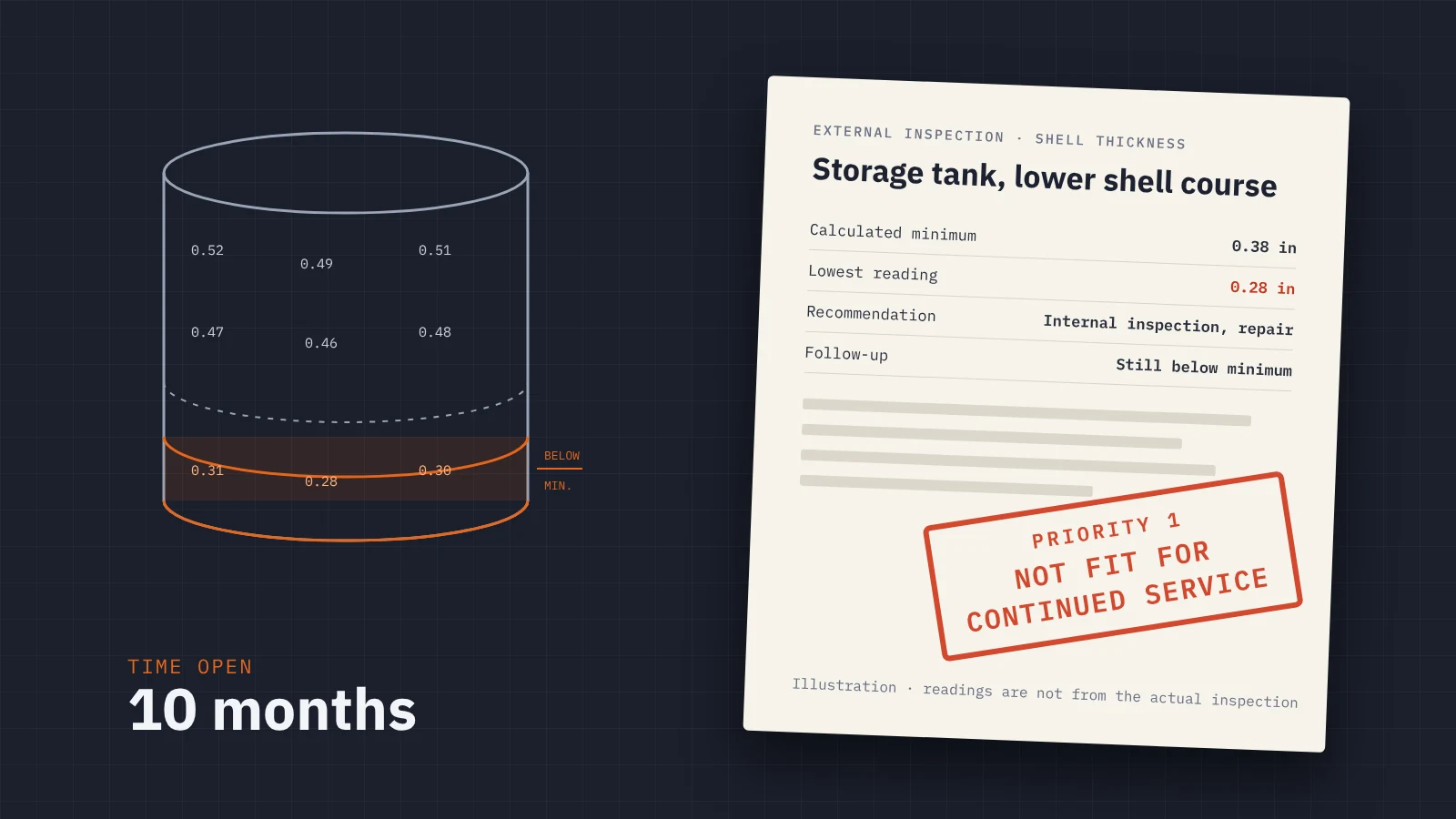
On the morning of May 26, 2026, a 1.2-million-gallon storage tank at a pulp and paper mill in Longview, Washington, failed. About 900,000 gallons of white liquor, a hot caustic solution at around 200°F, came out across the site minutes after the day shift started arriving. Eleven people died. Three more were seriously injured, along with others treated and released, a firefighter among them.
The U.S. Chemical Safety Board published an update on August 28. Its investigation is still open and it has not stated a cause. What it has laid out is the record before the failure, and that record is hard reading for anyone who writes findings for a living.
What the record shows
In July 2025, an external inspection found the tank shell had thinned below its calculated minimum safe thickness. The contractor recommended an internal inspection and repair. The report put the recommendation at the top of its scale: not fit for continued service unless corrected, with a high likelihood and consequence of failure. It noted that the whole shell course would likely need replacing.
Follow-up external inspections in October 2025 and February 2026 found large areas still below minimum thickness. According to the CSB, the tank was not internally inspected or repaired in those ten months. It was not taken out of service, and its operating conditions were not reduced. On the day of the failure, a process upset stopped liquor leaving the tank while it kept flowing in. The level reached about 90 percent by 6:22 a.m. The tank failed at about 7:09.
CSB Chairperson Steve Owens said the board was "greatly concerned that the tank was not promptly removed from service or properly repaired."
The board will say why in its final report. We won't guess at it here. The part worth sitting with now is simpler. The hazard was found. It was measured and written down three times, by people who knew what they were looking at.
Where findings go to wait
Most of us who investigate incidents have seen a version of this, at a smaller scale. The finding is right. The recommendation is right. Then it goes into a system where nothing forces the next step.
The patterns are familiar:
- The action has a department against it but no person, so everyone assumes someone else is on it.
- The permanent fix needs an outage and a budget, so it waits for the next turnaround, and nothing is done in the meantime.
- The report is filed as complete when the actions are assigned. Nobody's job is to check that the risk actually changed.
- Repeat findings get logged as repeats. The third inspection that says "still below minimum" reads like the first, when it should read as an escalation.
None of these are exotic. They come from the ordinary pressure of running a plant, and from tools that treat an action as a line in a register rather than a commitment with a date and a test.
What a closable action looks like
When we write corrective actions, we hold each one to a few plain tests.
It traces to a finding. If you can't point to the finding and the evidence behind it, the action is a wish. The trace also matters later, when someone asks why the money was spent.
It has an owner and a date. A role that can actually do the work, and a horizon that fits the risk. "Maintenance to review" is not an owner.
It separates today from the permanent fix. If replacing a shell course takes months, the question for the interim is what changes this week. Derate the tank or cap the fill level. If neither is safe, take it out of service. The hierarchy of controls applies to the gap between finding and repair as much as to the repair itself.
It says how we will know it worked. Closure needs evidence, such as the inspection record or the new thickness readings, and a measure of effect. Then someone goes back after a while and checks that the fix held.
That last step is the one most systems skip. An action marked complete is a statement about paperwork. A fix that held is a statement about the plant.
How Intero handles the follow-through
We built Intero around investigation, and this part of the job shaped a lot of it.
In Intero, every finding cites the case's evidence, by an exact quote or a photo observation, and says what it rests on. Every corrective action has to trace to at least one finding, and an action that doesn't can't go live. Actions are written up the hierarchy of controls, each with an owner role, a horizon, the evidence that will close it and how its effect will be measured.
An immediate action goes live in the CAPA tracker as soon as it has an owner. It doesn't wait for the full report to be signed off. The rest go live at approval. Owners see theirs in My CAPAs, and the tracker shows owner workload and how fast actions are closing.
When an action is finished, its owner is asked, by its horizon, "Did the fix hold?" Intero also looks through later cases at the organisation for the same failure coming back and puts what it finds beside the question. The owner still makes the call. The point is that someone is asked, on a date, with the evidence in front of them.
You can read more about how a case runs in Intero and what the workspace includes.
The part software can't do
No tool would have replaced that shell course. Somebody has to decide to spend the money and take the outage, or shut the tank down. What a good system can do is make the decision visible. A Priority 1 finding should have an owner and a date on the day it is written, with an interim control if the fix will take time, and it should be impossible for it to sit for ten months without someone noticing it is still open.
The Longview investigation will produce recommendations of its own. Until then, it is worth opening your own action register and sorting it by age.
If you want to see how Intero takes a case from the first report to the read-back, book a demo.
---
Sources
- U.S. Chemical Safety Board, update on the investigation into the fatal tank failure at the Nippon Dynawave Packaging facility in Longview, Washington, August 28, 2026.
- OPB / Associated Press, Longview chemical tank was called unfit for service before deadly failure, investigators find, August 28, 2026.